
Small Finds #4
At the grave of George Mackay Brown


It took some finding, the grave of the poet, but as soon as I saw it I knew. No other stone in Warebeth Cemetery had such offerings laid before it.
George Mackay Brown wouldn’t have liked that last sentence.
From the Red Cross shop in Stromness, a short walk from his old flat, I had bought a hardback collection of diary pieces he wrote for The Orcadian. In an entry from February 1982 he notes that he finds the word ‘cemetery’ too stark and cold, preferring ‘kirkyard’ for its feeling of community. The place itself, where generations of Stromnessians have been buried, he found warm and interesting, not gloomy. The sun was shining, he wrote, and the spring flowers would soon be out, and the certainty of death – as embodied by the kirkyard – made these sweet things sweeter. His father had died suddenly in 1940 and was buried at Warebeth, ‘at rest’ – as Brown put it – ‘with fishermen, farmers, merchants, sailors and their women-folk’. Their conversation, he imagined, continued beneath the sod, the eternal wagging of ‘salt and loam tongues’.
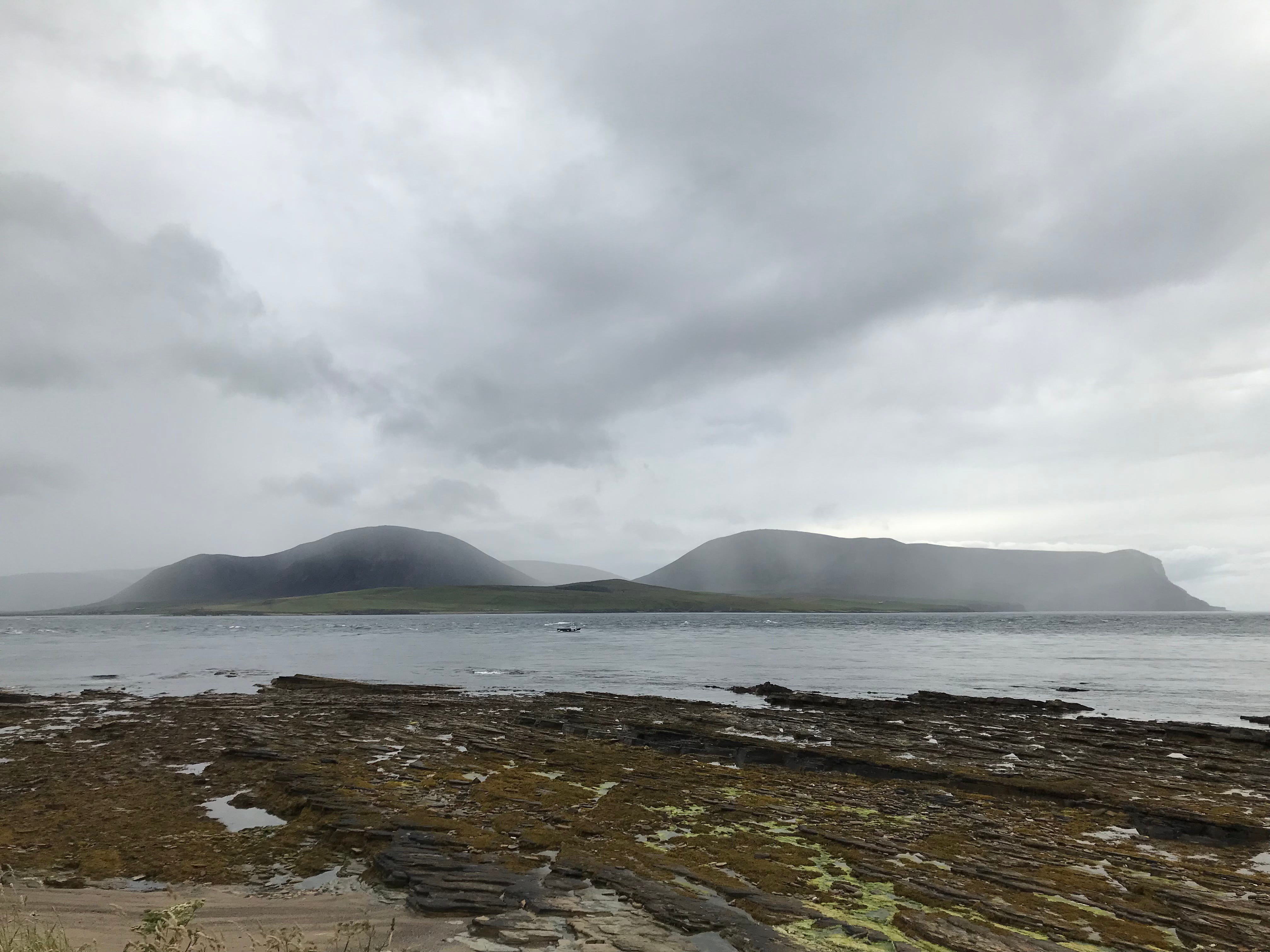
He is buried next to his parents, John and Mary. Warebeth is about a mile outside Stromness, right on the coast. The sound of the waves is ceaseless. The island of Hoy looms to the south.
Brown’s headstone tells us who and what he was – a poet. It doesn’t say that he was Orkney’s laureate, singer of the islands, to the islanders a bringer of song, but then no-one coming to this spot would need telling. Below his dates, 1921-1996, there are four symbols: the sun, a star, a ship and a stalk of corn. These are taken from his final poem, as are the words inscribed around the stone:
Carve the runes
Then be content with silence.
I was alone in the cemetery, or as alone as you can be among the dead, but there had been many pilgrims before me. The ground around Brown’s grave was crowded with tokens: scallop shells, a wooden lighthouse, a copper angel, a pottery cat, a tile with Julian of Norwich’s All Shall Be Well and All Shall Be Well spiralling around its face. Mostly, though, what people had left were stones brought up from the beach, worn round and smooth by the loving rub of the tide.
I had no stone to leave, so read aloud a few of Brown’s own words, in gratitude for him having written them.
‘Sometimes I see my task, as poet and storyteller, to rescue the centuries’ treasure before it is too late. It is as though the past is a great ship that has gone ashore, and archivist and writer must gather as much of the rich squandered cargo as they can.’
A ferry passed through the Sound of Hoy, a Viking warrior on its hull. The hills beyond its funnels were black against the sky.
What perfect words to carve on a gravestone
Evocative, uplifting, as always Peter. Like GMB himself.